Tarot foundations
How a tarot deck is structured
A standard modern deck has 78 cards. Learning its architecture first turns a pile of unfamiliar images into a small set of recurring patterns.
Two sections, different scales
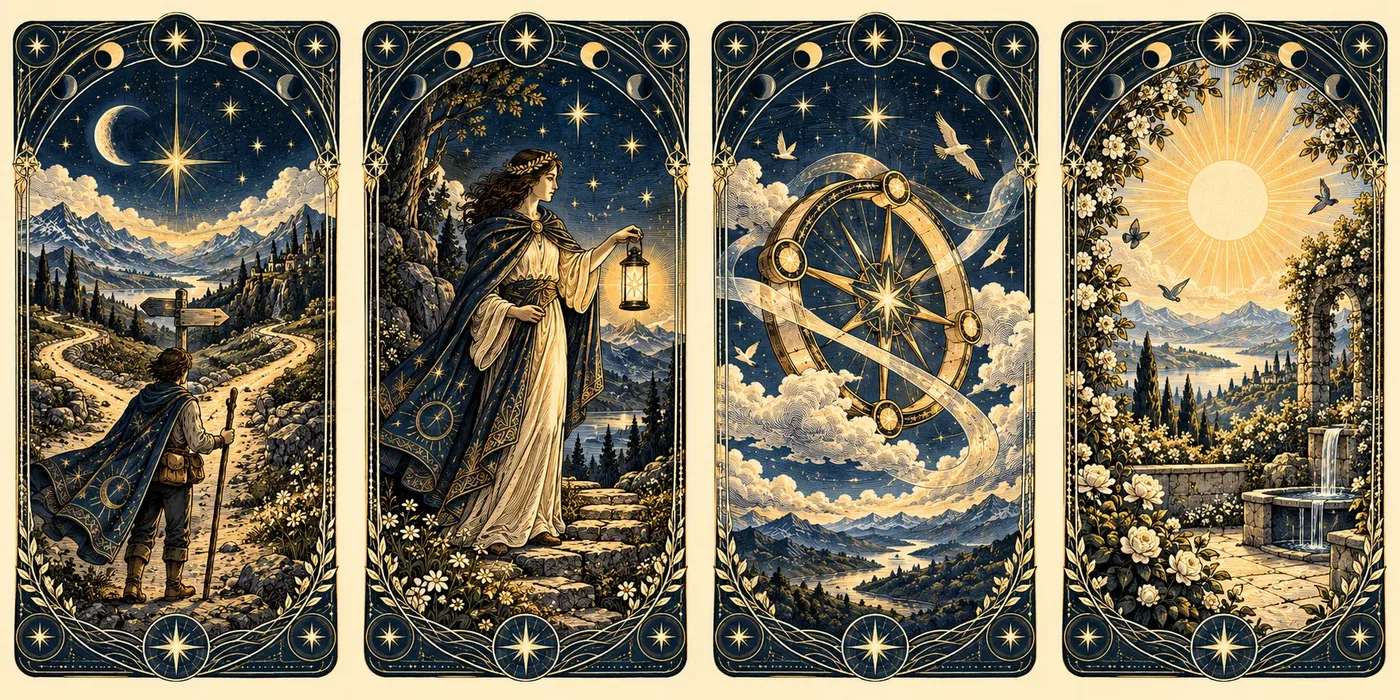
The deck divides into 22 Major Arcana and 56 Minor Arcana. Modern readers often use the Major Arcana for experiences that feel like thresholds, roles, or large themes—the Fool beginning, the Hermit withdrawing to examine, or the Tower confronting disruption. That does not make these cards an announcement of unavoidable events. Their scale is interpretive: they ask you to consider the larger pattern around the question.
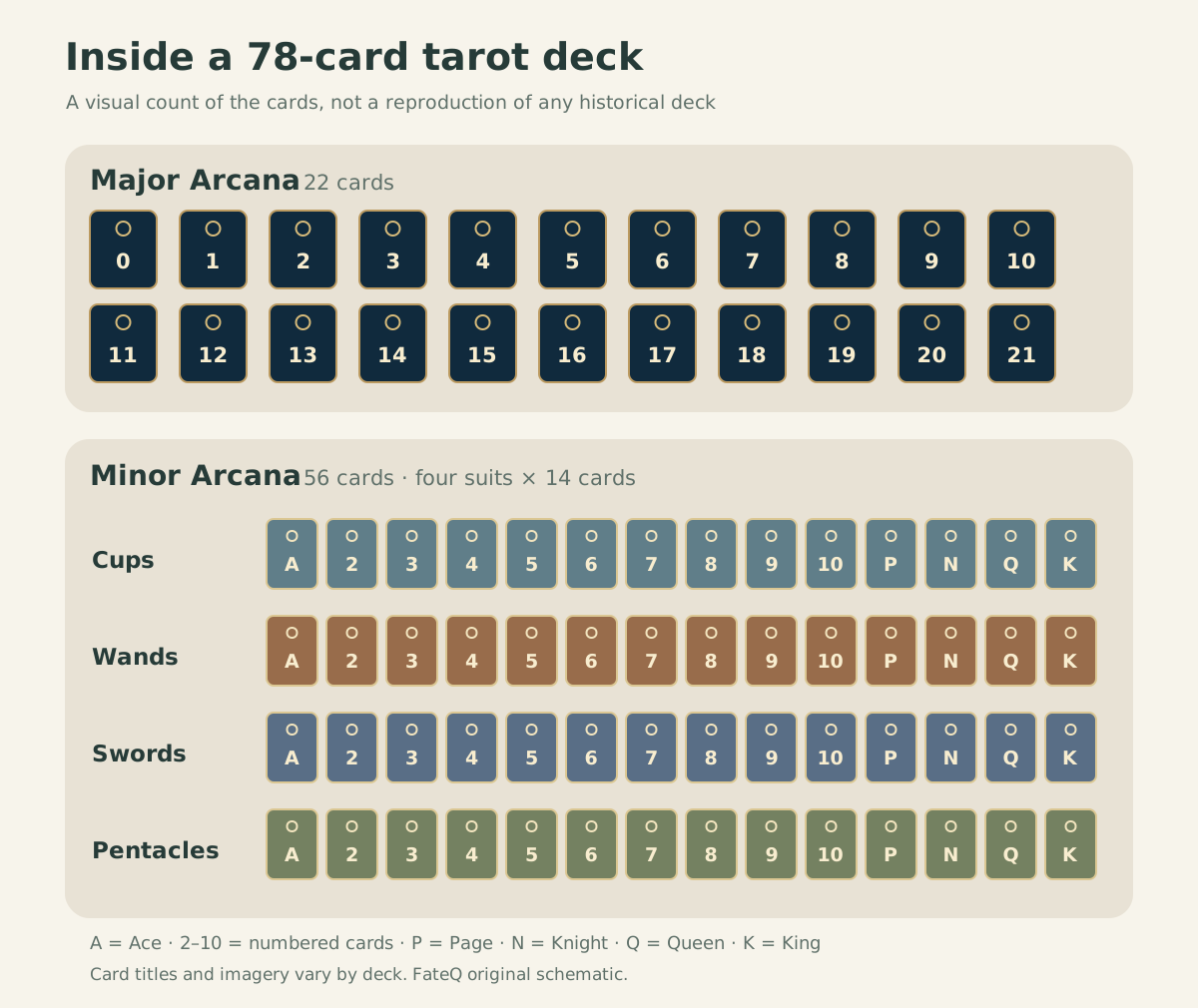
The Minor Arcana is closer to daily texture. Its 56 cards are divided into four suits, each with Ace through Ten plus four court cards. In many decks the suits are Wands, Cups, Swords, and Pentacles, though names and visual systems vary.
A practical map of the suits
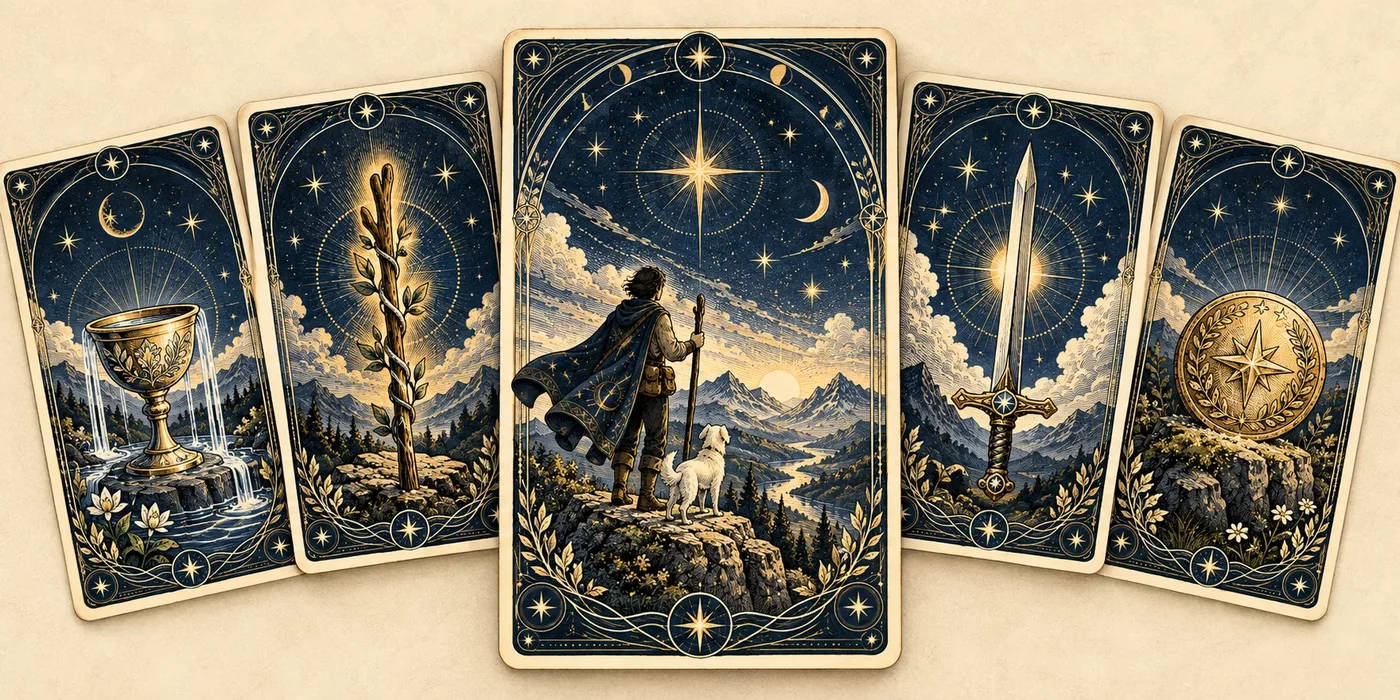
- Wands often frame energy, effort, desire, or initiative.
- Cups often frame emotion, connection, imagination, or receptivity.
- Swords often frame thought, language, decisions, or conflict.
- Pentacles often frame material conditions, work, resources, the body, or stewardship.
These are conventions, not natural laws. Check the deck’s own imagery and guidebook when its system differs.
Number and suit work together
A useful beginner method is to combine a card’s number with its suit. An Ace can suggest emergence or concentrated potential; a Two can introduce pairing, choice, or tension; a Ten may suggest culmination, consequence, or a cycle reaching capacity. The Five of Cups, for example, joins the “five” idea of disturbance with the suit’s emotional register. The picture then tells you what kind of disturbance this particular deck imagines.
No number has to mean exactly one thing. Look across several cards with the same number and ask what changes when the suit changes. This comparative method builds understanding more reliably than memorizing 78 isolated sentences.
Court cards can be roles, styles, or people
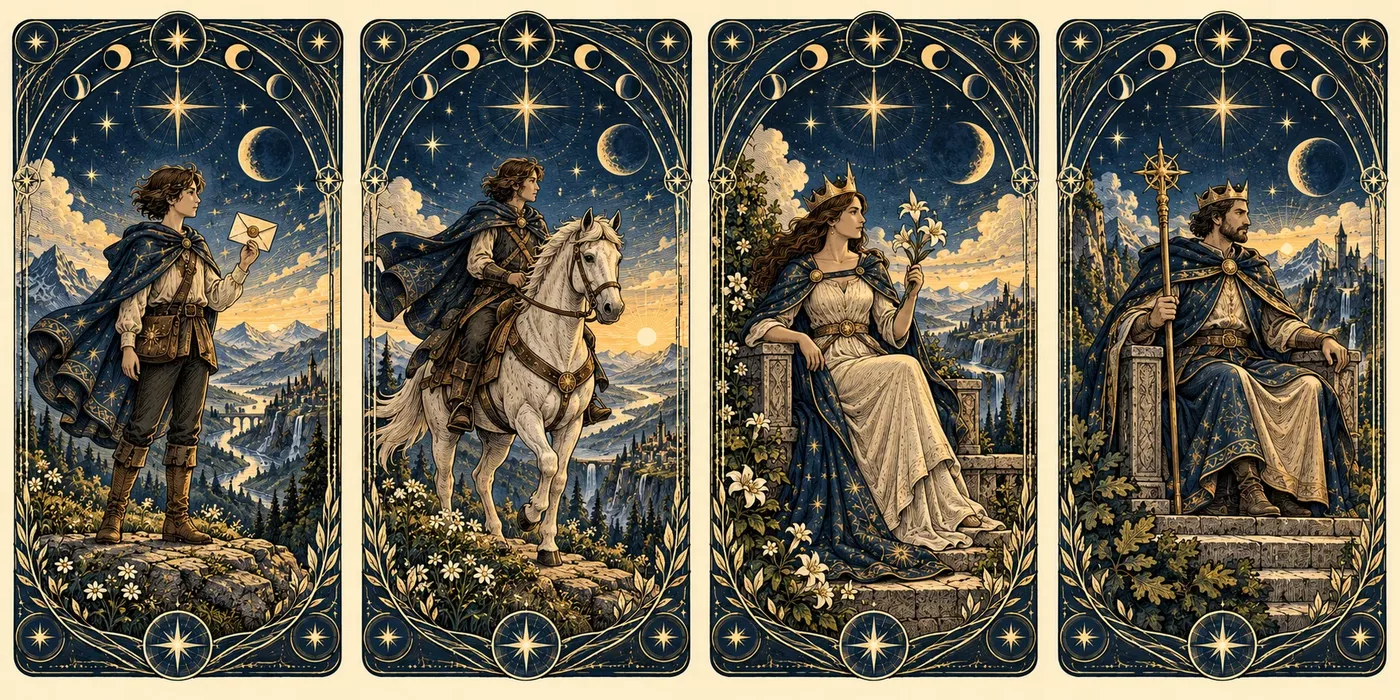
Most decks have four court ranks in every suit. Their names commonly appear as Page, Knight, Queen, and King, but newer decks may rename them. A court card can point to an actual person; it can also describe a way of approaching the issue. A Page of Swords might invite curious questioning, while a King of Swords might emphasize considered judgment and responsibility for a decision.
Before deciding that a court card “is” someone, test three possibilities: a person involved, a quality you are using, or a quality the situation asks you to develop. The surrounding cards and the original question should decide which reading is most coherent.
Why decks do not all look alike
Tarot grew through games, art, occult systems, and publishing traditions. The widely influential deck often called Rider–Waite–Smith was published in 1909 and illustrated by Pamela Colman Smith. Its fully illustrated Minor Arcana made narrative reading especially accessible, but Marseille-style, historical, and contemporary decks can organize symbols differently.
When learning a new deck, identify its lineage, read the creator’s notes, and notice whether it changes suit names, court ranks, card order, or cultural references. Respecting the specific deck is part of reading it well.