Understand the map
Schools and basic ideas
Learn why Form and Compass approaches can produce different advice, and what this guide does—and does not—claim.
Compare the approaches →Feng shui · Home and form
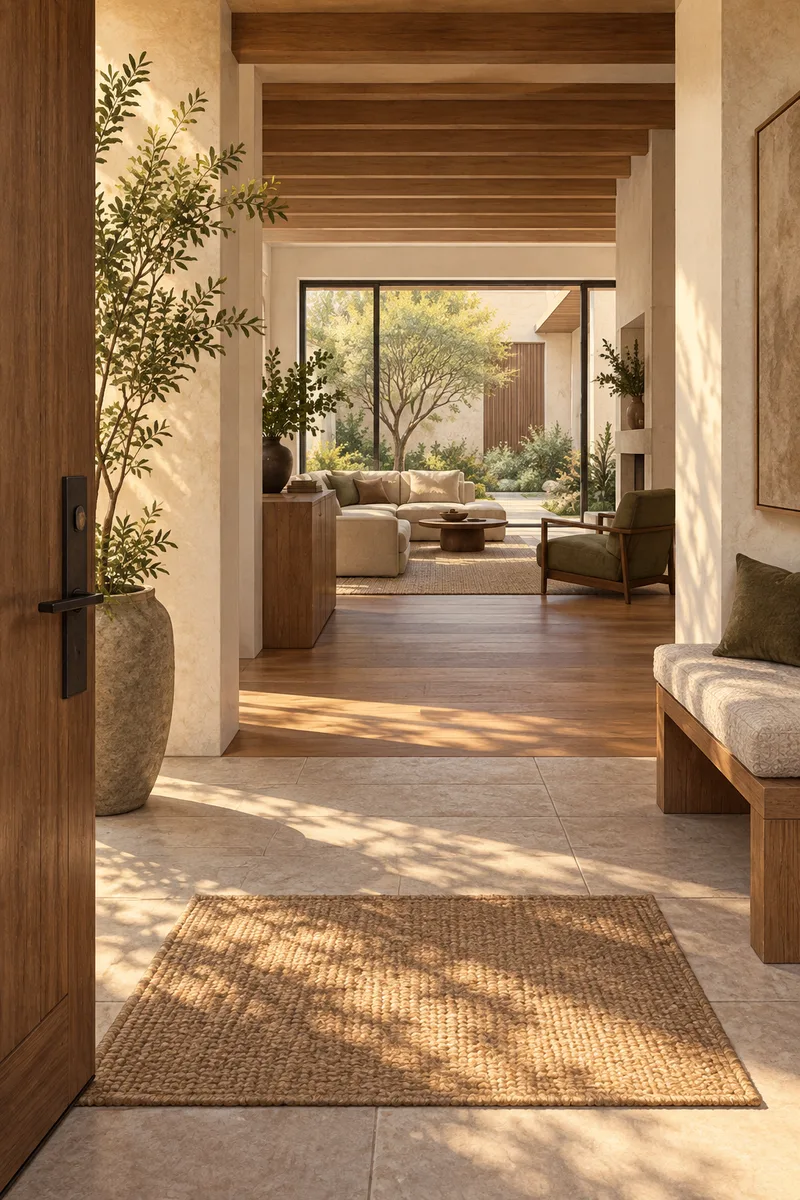
Begin with what a space makes possible: a supported place to rest, a visible route through the room, useful light, and furniture that fits real daily movement.
FateQ mainly uses a Form School lens, which attends to physical configuration and relationships in space. Compass traditions use directions, time, and calculations; this guide does not collapse the two into one universal rule.
Understand the map
Learn why Form and Compass approaches can produce different advice, and what this guide does—and does not—claim.
Compare the approaches →Walk the route
Use arrival, sightlines, support, and movement to observe where a home feels clear or unnecessarily difficult.
Take the home walkthrough →Read the landscape
Assess approach, shelter, drainage, water, planting, paths, and changing weather without treating a feature as a wealth formula.
Walk through the courtyard →Design for choice
Review edges, views, privacy, circulation, and seating options in lounges, waiting rooms, libraries, and shared spaces.
Audit a shared room →Place key furniture
Apply Form School ideas to bed and desk positions while respecting safety, access, rental limits, and room size.
Review the placement guide →Work with constraints
Prioritize circulation, visible zones, storage, and sleep-work transitions when one room has several jobs.
Plan a reversible room test →Our point of view
Feng shui has a long and varied history. Earlier terms included practices concerned with divination, dwellings, landforms, and the relations described through yin–yang and other cosmological systems. The label “feng shui” became common later; it should not be treated as one unchanged method.
In these home guides, “good” means a layout supports the activity you intend, is safe to use, and feels workable to the people who live there. Symbolic language can enrich observation, but it does not guarantee health, wealth, romance, or luck.
Choose a lens
Each path has its own history and vocabulary. FateQ presents these traditions and relationship prompts as frameworks for observation and self-inquiry—not as proof of personality or a fixed future.