Landscape and threshold
Read a courtyard through form, water, and shelter
A courtyard is not an isolated ornament. It mediates between building, weather, path, planting, and view. A Form School reading begins with those relationships before attaching luck to a fountain or pond.
Start with the form around the courtyard
Form School traditions grew from close attention to landform, approach, enclosure, orientation, and water at the scale of sites and settlements. A domestic courtyard is a much smaller setting, so translating those ideas requires restraint. Look first at what contains the space, where it opens, and how a person enters and leaves.
Stand at the main threshold and notice whether the courtyard feels completely exposed, tightly enclosed, or graduated between the two. Walls, eaves, trees, and covered walks can provide shelter; openings can offer distance and orientation. Neither enclosure nor openness is automatically better. Climate, privacy, daylight, ventilation, and the courtyard’s actual use decide what balance is workable.
Follow the approach before judging the center
Walk the route from the dwelling to the courtyard and through any gate beyond it. Can two people pass without stepping into planting? Are changes in level visible? Does the path lead to a usable destination, or does it end at a decorative object with nowhere to pause? Form-based reading is strongest when it follows movement rather than reducing a plan to a lucky sector.
Also look back toward the house. A beautiful view from the garden can coexist with an awkward view from the rooms used every day. Check the sightline from doors, frequently used windows, and seating at different times of day. A focal stone, tree, or water surface works best when it helps orient the space without blocking a route or becoming the only reason the courtyard exists.
Treat water as a site condition, not a wealth switch
Water is important in feng shui vocabulary, but there is no responsible basis for promising that a pond size, direction, or flow will create wealth. In a practical Form School adaptation, water draws attention to movement, collection, edge, and relationship with surrounding terrain. Those qualities can be observed without turning them into a guaranteed outcome.
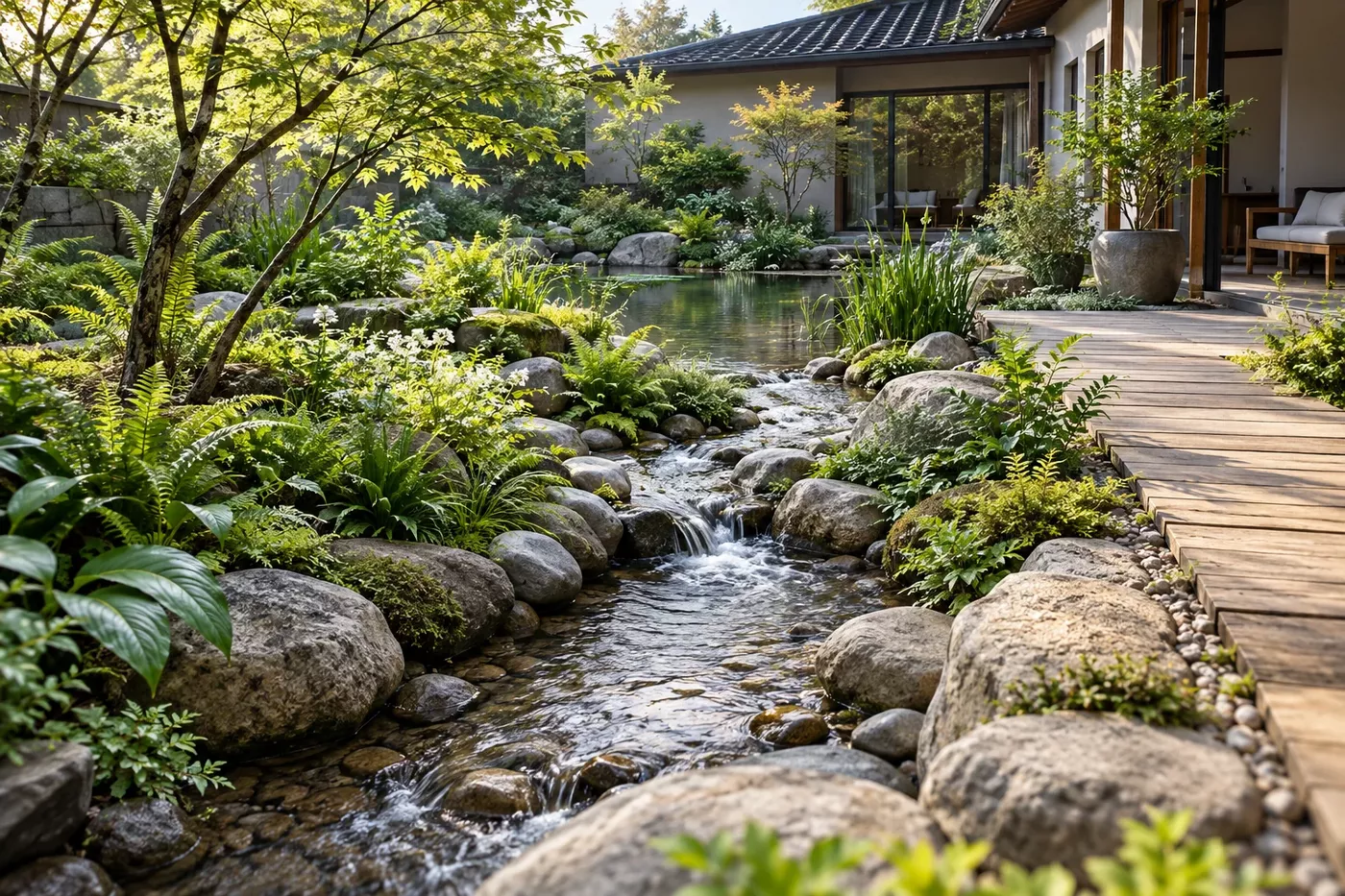
For an existing feature, trace where water comes from, where it goes, and what happens during heavy rain or a power failure. Check overflow, drainage away from the building, slippery edges, safe access for children and animals, pump noise, water quality, and the labor required to keep the feature functioning. Local building, electrical, water-use, and mosquito-control requirements take priority over symbolic advice.
Read stillness and movement together
A calm surface can reflect sky and foliage, while moving water can mask nearby noise and make a route feel active. Either can also create glare, constant sound, maintenance problems, or an unsafe edge. Sit in each likely position long enough to hear the pump, see reflections, and notice whether the feature settles attention or demands it.
If the courtyard has no water, do not assume it is incomplete. Paving that drains well, planting that responds to wind, and a clear path can express movement without a constructed pond. If a water feature is failing, removing it may be more coherent than preserving it for fear of symbolic loss.
Make more than one kind of refuge
A courtyard often needs choices: sun and shade, a seat near activity and another slightly apart, an open view and protection from wind. Avoid creating refuge by narrowing accessible routes or hiding hazards behind dense planting. Night lighting should reveal steps and water edges without producing glare into windows or neighboring homes.
Planting also changes. Ask how roots, mature canopy, leaf drop, and seasonal sun will affect roofs, drains, paving, and visibility. A design that looks balanced on installation day may become crowded or exposed later. Form is a relationship over time, not a frozen composition.
Test the courtyard in real conditions
Review the space after rain, during the hottest part of the day, at night, and when several people use it. Record where water gathers, which seat is chosen first, where conversation carries, and which route becomes inconvenient. Improve one repeated problem at a time and observe the result before adding a symbolic object.