Two-card reading
Read complementary tarot images as one conversation
When two cards echo, continue, or complete one another, the useful meaning often lies in the connection. Read that bridge carefully instead of merging both cards into one agreeable message.
Give each card one clear job
Choose the positions before drawing. A pair might answer resource / next use, what I know / what supports it, or first movement / second movement. Without defined positions, a reader can rearrange the relationship after seeing the images and make almost any story fit.
Keep the question open and usable. “What two qualities can I bring to this conversation?” leaves room for observation and choice. “Will these cards guarantee agreement?” asks the images to establish an outcome they cannot know.
Describe the cards separately first
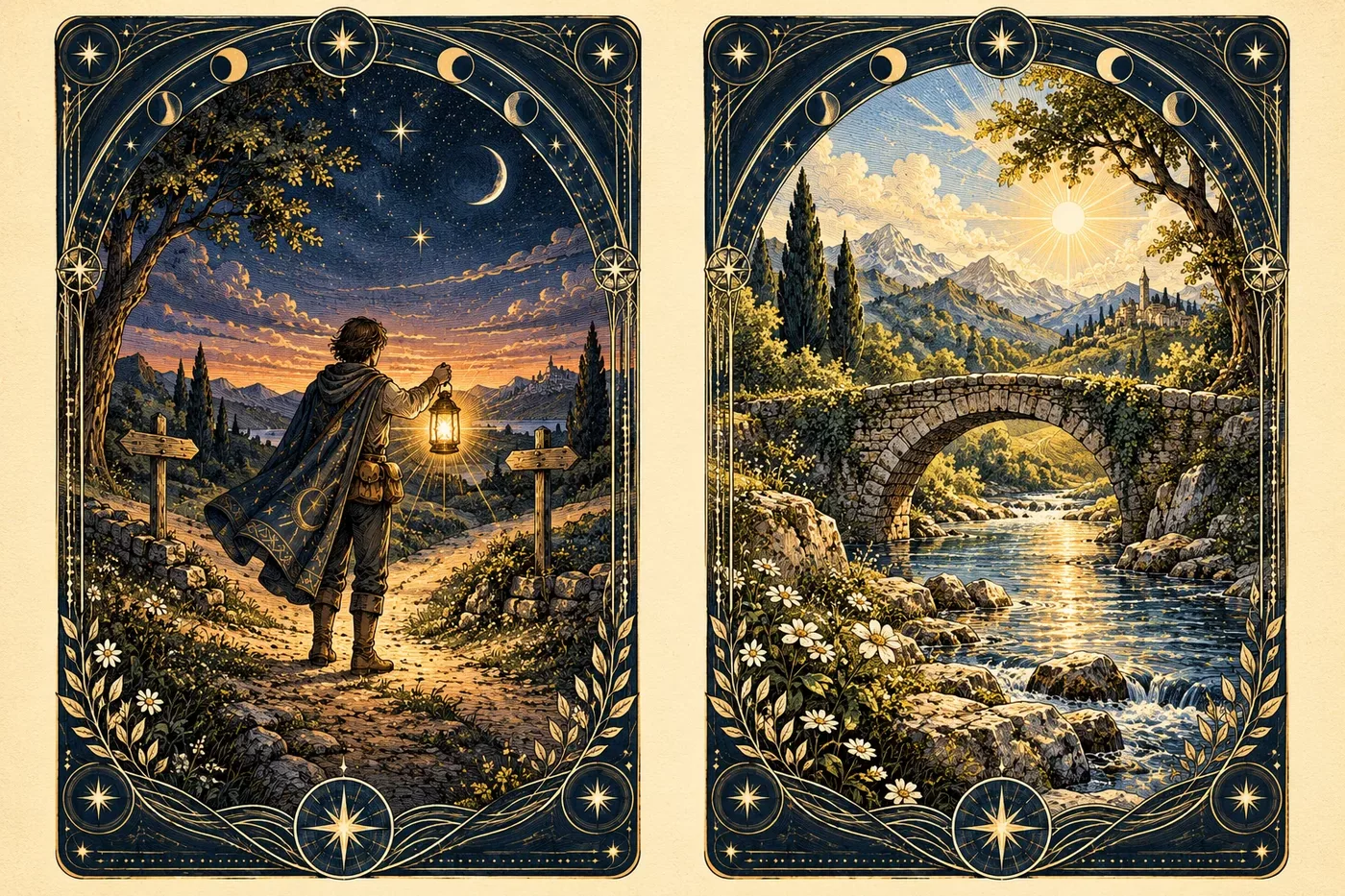
Cover the second card and write three visible details from the first: a figure’s action, the setting, and where movement or attention points. Repeat with the other card. Use nouns and verbs before interpretive labels. “A person carries a lantern at a fork” is evidence; “the right decision will be revealed” is already a prediction.
Next, note tone without declaring value. A dark sky may feel quiet, uncertain, protective, or spacious; bright sunlight may feel clarifying, exposed, energizing, or overwhelming. Complement does not mean that the darker image is a problem and the brighter image is its promised solution.
Find the visual hinge
The hinge is the detail that lets one image speak to the other. It might be repeated direction, color, landscape, gesture, object, or scale. It can also be a sequence: searching followed by crossing, holding followed by sharing, or detail followed by overview. Name the visible link before deciding what it means.
In the illustrated pair, both cards contain a route. The first places a lantern-bearing traveler at a fork; the second opens onto a bridge under daylight. One possible hinge is finding enough orientation to cross. Another is moving from private inspection to a more exposed passage. A third reader might notice that the bridge constrains movement to one span while the crossroads offers alternatives. The pictures support all three; the positions and question decide which deserves attention.
Test four complementary relationships
- Continuation: Does the second image extend an action begun in the first?
- Support: Does one card provide a condition, tool, or perspective the other lacks?
- Scale: Does one show an inner process while the other shows its practical setting or consequence?
- Qualification: Does the second card make the first more specific, slower, narrower, or more accountable?
Write one sentence for at least two relationships. If only one story seems possible, deliberately reverse the order and see what changes. The exercise is not meant to prove the reversed reading; it reveals assumptions hidden in the first one.
Do not force agreement
Repeated symbols can amplify a concern rather than resolve it. Two images of movement might show helpful momentum, avoidance of stillness, or competing routes. A gentle-looking pair can still ask a demanding question. A complementary reading should preserve what differs between the cards even while explaining what connects them.
Guidebook meanings can enter after the visual pass. Check how the deck creator frames each card, then ask whether those conventions reinforce or complicate the hinge you found. Do not erase a deck’s cultural or artistic context in the name of intuition.
Return the pair to ordinary language
Complete three short lines: “Card one contributes…”, “Card two contributes…”, and “Together they ask…”. End with a modest action you can observe, such as gathering one missing fact before crossing a threshold or naming which option still needs light. The action comes from the reader’s situation, not from a promise embedded in the artwork.