Palm Mounts and Finger Landmarks
In an older manual the “third finger” can mean the ring finger. Starting your count at the thumb would put the label on the wrong spot. Start by naming the finger in ordinary language, then follow it down to the palm.
Orient the map
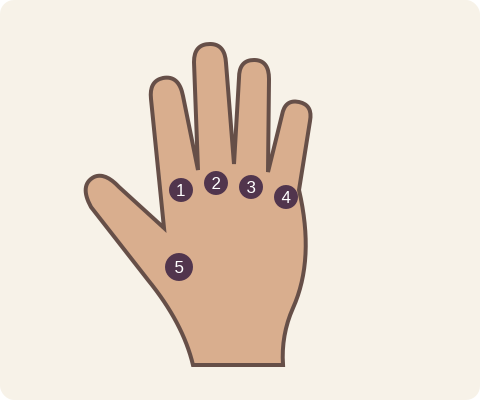
With the palm facing you, find the index finger next to the thumb. Follow its center down across the finger base onto the palm. Repeat for the other three upright fingers. You are looking at the surface on the palm side just below each base. If a cushion is hard to distinguish, the attached finger is still a usable landmark.
Match the finger before choosing the name
- Below the index finger: Jupiter.
- Below the middle finger: Saturn.
- Below the ring finger: Sun or Apollo.
- Below the little finger: Mercury.
- On the fleshy ball at the base of the thumb: Venus. This region follows the thumb side of the palm, lower than Jupiter.
In Palmistry for All (1916), Part II, Cheiro uses “Sun” for the ring-finger region and also gives “Apollo.” Niblo’s The Complete Palmist uses Apollo and identifies the Sun as an alternative. Two headings in two books can therefore lead to the same patch of skin. Other named regions extend beyond these five; this map is limited to landmarks you can locate from the fingers and thumb.
Try a reading with the labels covered
Rest your own hand loosely. Locate the base of the ring finger and describe only the shape below it, for example “a gently rounded area beside a flatter area under the little finger.” Look again after relaxing fingers that were held tightly together. If the edges are indistinct, say so. Feeling a soft contour with a light touch is optional; no pressure test or measurement is needed.
Now uncover the label. “Mount of the Sun” is something you learned from a manual. Cheiro associates it with appreciation of beauty. You can verify that the author made the association by looking up the passage. You cannot verify someone’s artistic ability by looking at their palm. If a person wants to talk about art, asking what they enjoy making gives them room to answer in their own terms.
For descriptions at a larger scale, see hand outlines and finger proportions. To trace a fold instead of locating a surface region, use the major-line map.